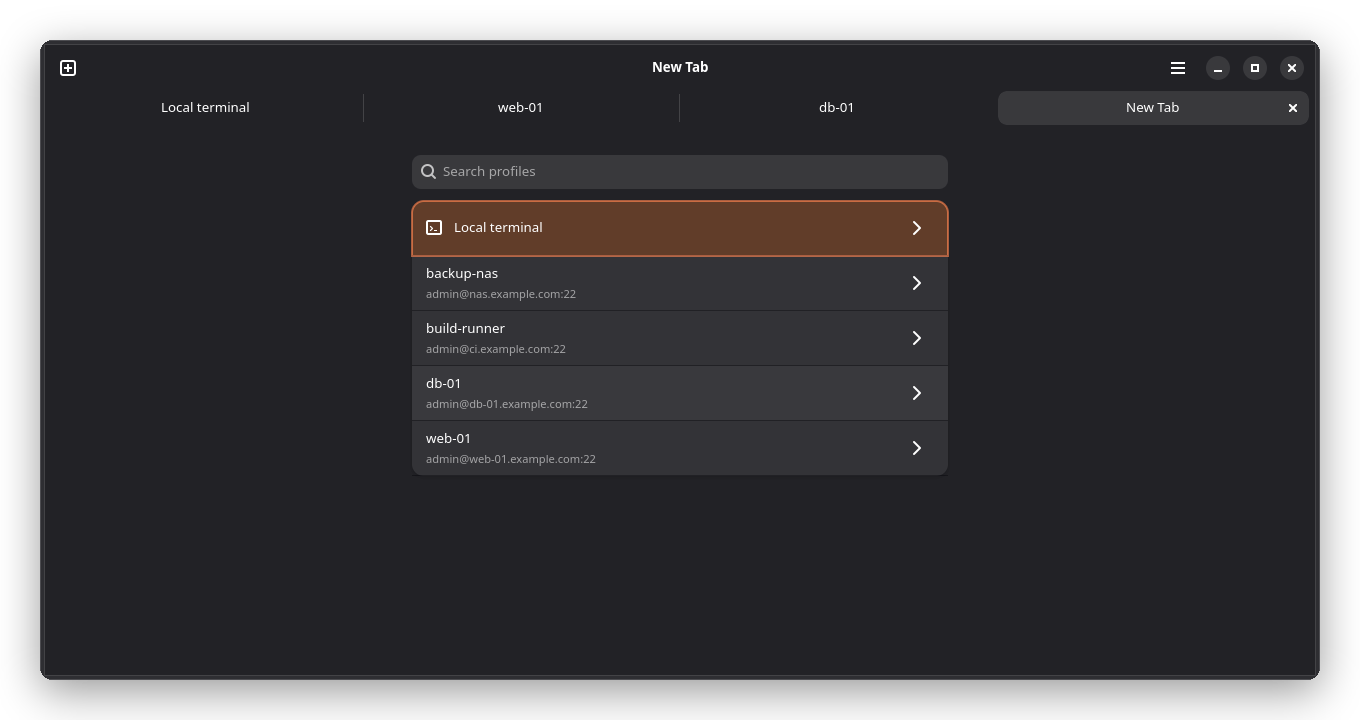
Moniker is free and open source. It is a terminal for Linux built around saved SSH connections. Pick a saved connection and your new tab opens already logged in, with nothing to type. There is no cost, no account, no cloud service, and no telemetry, and the full source code is available under the MIT license.
Why Moniker?
If you log in to the same servers many times a day, you type the same host, user name, and password every time, then the same commands after every login, such as apt update. Keeping that list in step between a laptop and a desktop means doing it by hand, or handing your passwords to a vendor’s cloud, usually behind a subscription. Moniker saves each connection as a profile and syncs the profiles between your own machines over plain SSH, with no server in the middle.
What it does
- Logs you in with one click. A profile holds the host, user name, port, an optional key file, and a password. Pick it from the new-tab list and the tab logs in.
- Runs startup sequences. Give a profile named lists of commands, such as “Update” or “Disk space.” Connect with one and its commands run after login, leaving you in your normal shell.
- Syncs without a server. Profiles and passwords sync between your own machines over SSH, changes merge both ways, and Moniker syncs in the background each time it starts. A headless server can join in with the
moniker-servercommand line. - Keeps transcripts. Save a plain-text transcript of any session, then browse, filter, and search them in the Transcripts window. They never leave the machine.
- Works like a real terminal. It is built on VTE, the engine behind GNOME Terminal, so
htop,tmux, andvimwork as you expect, with tabs, multiple windows, and the modern GNOME look.
Built to keep your passwords safe
Moniker keeps passwords in your system keyring and never puts them in a file, on a command line, or in an environment variable. It runs your system’s own ssh, so your ~/.ssh/config and known hosts still apply, and a small helper answers the password prompt only when it names exactly that profile’s user and host. A wrong stored password is tried only once.
Sync encrypts profiles and passwords before they leave the machine, with a key derived from a sync key that you set on each of your machines and that is never sent. It also refuses any host whose SSH host key it doesn’t already know. Any machine with your sync key can read your synced passwords, so set it only on machines you control, and make it long.
Get it
Moniker is a native GTK 4 and libadwaita application for Linux, written in Rust. Ready-made .deb and .rpm packages for Ubuntu 26.04, Fedora 44, or newer (x86-64) are on the releases page, with checksums and a build attestation that shows GitHub built them from the public source code. You can also build it from source. The repository has the instructions.
Moniker is alpha software (version 0.4.0), so expect a few rough edges. The README lists its known limitations.
Get Moniker on GitHub. Because it is open source, you are welcome to read the code, report problems, suggest improvements, or send a pull request.